
What to Look for in a Strategic Dental Lab Partner
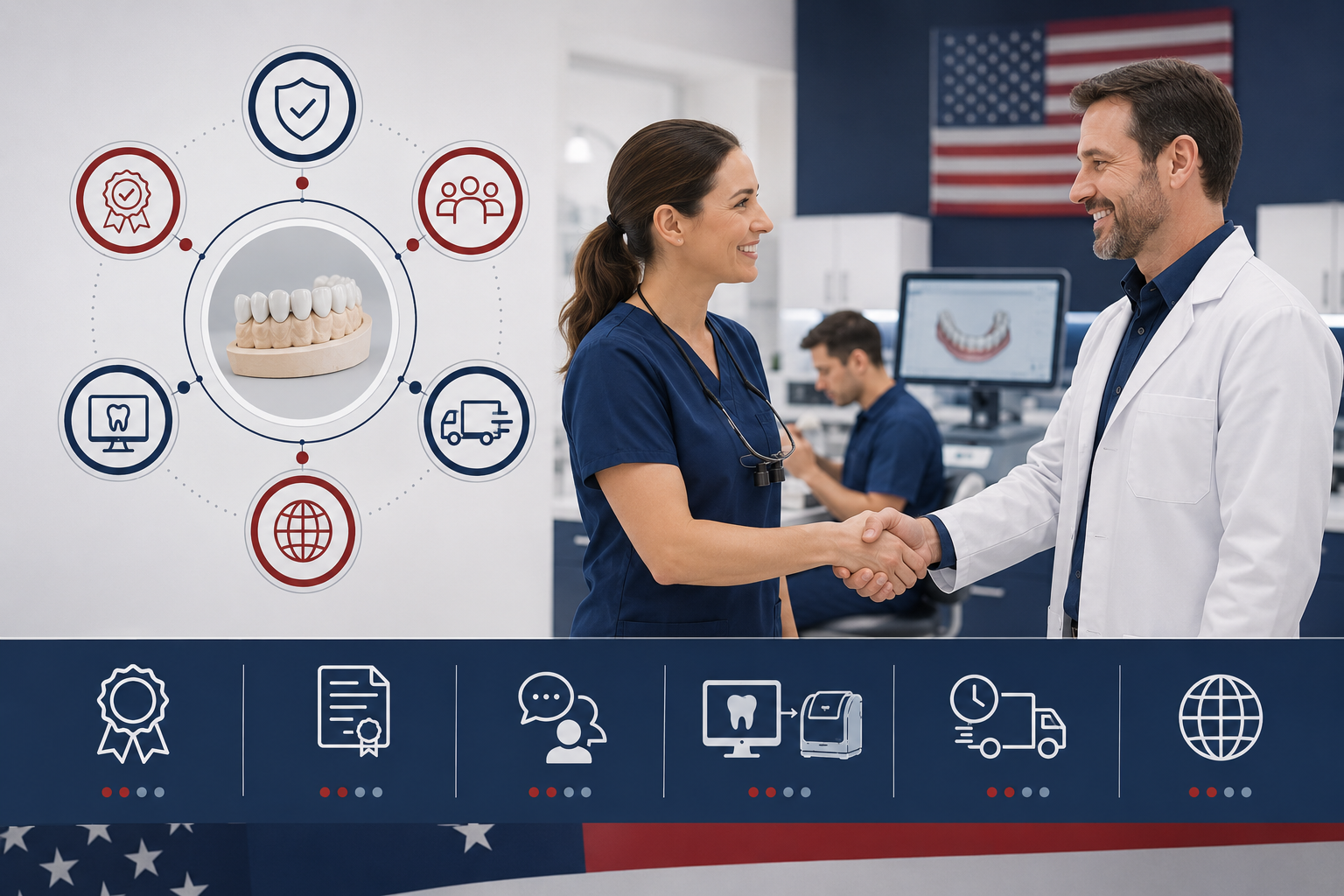
For most of the history of restorative dentistry, the relationship between a dentist and a dental lab was a vendor relationship. The dentist sent cases. The lab made restorations. The relationship was measured by price per unit, turnaround time, and how forgiving the lab was when a case needed to be remade. There was little expectation of strategic input, and even less expectation that the lab would actively contribute to the growth of the practice.
That model is increasingly outdated. The most successful practices in the United States today do not have a vendor lab. They have a lab partner — a relationship built on shared standards, mutual investment in quality, real communication, and a clear understanding that the lab's success and the practice's success are linked. When the lab delivers consistently excellent restorations, the practice grows. When the practice grows, the lab grows. The economics of that alignment are different from the transactional model, and so are the outcomes.
This article walks through the specific criteria that distinguish a true strategic dental lab partner from a transactional vendor. Whether you are considering a switch, evaluating multiple labs, or just trying to get more out of your current relationship, these are the questions that matter most.
The Difference Between a Vendor and a Partner
Before getting into the specific evaluation criteria, it helps to be clear about what a partnership relationship actually looks like in practice. A vendor lab quotes you a price per unit, ships you crowns, and remakes the cases that come back as obvious failures. The conversation is essentially over once the case is delivered. Future business depends on whether you keep submitting cases and whether the lab keeps delivering them.
A partner lab takes a wider view. It cares about how the case fits at the seat appointment, not just whether it leaves the lab. It is invested in your remake rate as a clinical metric, not as a customer service metric. It pays attention to the patterns in your cases — the materials you favor, the contour preferences you have, the way you like contacts adjusted — and it builds those preferences into the way it produces your work. A partner lab is the one that calls you to suggest a better solution to a tricky case, not the one that just produces what was asked for and waits for the next prescription.
The difference matters because the most expensive dental lab in your career is not the one that charges the highest fee. It is the one that produces inconsistent work, slows down your schedule, and forces you to compete on chair time you should be reclaiming. A truly strategic partner is almost always cheaper in real terms, even when their published fees are higher.
Criteria One: Technology and Equipment
The technology a lab uses is the foundation of everything else. A lab that is operating with outdated equipment, even if its technicians are excellent, simply cannot deliver the precision and turnaround that modern restorative dentistry requires.
The first thing to ask about is the lab's CAD/CAM infrastructure. Does the lab run modern five-axis milling units capable of producing zirconia, lithium disilicate, hybrid ceramic, titanium custom abutments, and PMMA provisionals in-house? Are these mills owned by the lab, or are cases outsourced to a milling center that the lab does not directly control? In-house milling means the lab controls turnaround, controls quality, and can prioritize urgent cases. Outsourced milling adds days to the cycle and creates a layer of communication that often costs the dentist time at the seat appointment.
The second is 3D printing capacity. A modern lab should have high-resolution printers in production for surgical guides, working models, custom trays, denture try-ins, occlusal splints, and increasingly for permanent restorations. The resolution of the printer matters, but so does the validation of the materials and the post-processing protocol. A printer running on undocumented parameters produces beautiful objects that do not always fit. A printer running on validated, documented protocols produces objects that fit predictably.
The third is intraoral scanner compatibility. A capable digital lab should accept scans from every major intraoral scanner on the market without requiring file conversions that introduce error. Ask which scanners the lab works with regularly, and ask whether the lab's CAD team can validate the scan quality immediately upon upload.
The technology question is not about which lab has the most expensive equipment. It is about whether the lab has the right equipment, well maintained, in current production, with documented quality control. A small lab running a modern, validated digital workflow will outperform a much larger lab running aging equipment with no documentation behind it.
Criteria Two: Communication and Responsiveness
The single best predictor of a strategic lab partnership is how the lab communicates. A lab that responds within hours, provides design previews before fabrication, and proactively reaches out when something looks off in a submission is a lab that is treating your cases as cases — not as units in a queue.
Ask specifically how the lab handles a question on a case. Do you get a return call within the same business day? Is there a dedicated point of contact who knows your practice, or are you routed to whoever picks up the phone? When you submit a complex case, does someone reach out to confirm the prescription before fabrication begins, or does the case enter production silently and arrive without comment?
The strongest digital labs run a case manager model, where each practice has a primary contact who knows the doctor, knows the typical cases, and knows the preferences. That person becomes effectively part of the practice's clinical team. Cases do not slip through gaps because someone is paying attention. Aesthetic preferences are remembered case to case. Special instructions do not have to be re-explained every prescription.
Ask one more question: when something goes wrong, who handles it? A lab that has a clear, fast process for handling remakes, adjustments, and clinical questions is a lab that has been doing this long enough to know that things will occasionally go wrong. A lab that gets defensive, slow, or evasive when something needs attention is showing you exactly what the relationship will look like under stress.
Criteria Three: Quality and Consistency
Quality in dentistry is not the same as luxury. A high-quality dental restoration is one that fits the prep precisely, integrates with the adjacent teeth, articulates correctly with the opposing arch, looks natural in the patient's mouth, and lasts for years without complication. Beautiful aesthetics are part of quality, but only the visible part. The invisible parts — margin fit, contact tightness, occlusal contact distribution, internal fit on a custom abutment — are what determine whether the restoration succeeds clinically.
Ask the lab for its first-time-fit rate. A capable digital lab should be tracking this number and able to share it. The benchmark in 2026 is 95% or higher for routine crown-and-bridge cases and 95% or higher for implant cases on validated workflows. A lab that does not track this number, or that tracks it but is unwilling to share it, is telling you something about how it manages quality.
Ask about the lab's quality control process. Is every case inspected before it ships? Is there a documented protocol for checking margins, contacts, and occlusion? Are there calibration records on the milling machines? Are material lot numbers tracked so that if a problem appears later, the lab can identify whether a specific batch of zirconia or lithium disilicate is involved?
Consistency matters as much as peak quality. A lab that delivers extraordinary cases occasionally but is inconsistent across the everyday workload is harder to integrate into a practice than a lab that delivers consistently very good work case after case. The practice's schedule depends on predictability. A predictable lab is a profitable lab partner.
Criteria Four: Turnaround and Reliability
Turnaround time is the metric that matters most to scheduling. A lab that promises five business days but delivers in eight is not a lab partner — it is a logistics problem. A lab that promises four business days and consistently delivers in three or four is a practice multiplier.
Ask for typical turnaround on the cases your practice produces. Single-unit crowns. Three-unit bridges. Custom abutments. Surgical guides. Full-arch implant cases. Dentures. Each case type has its own production cycle, and a strong lab will be transparent about what to expect.
Ask about rush capacity. Every practice has occasional cases that need to be expedited. A lab that can deliver a single-unit crown in two business days when needed, or a surgical guide in 24 hours, is a lab that gives the practice operational flexibility. That flexibility translates directly into the ability to accommodate emergency patients, complete cases before patients travel, and respond to unexpected clinical situations.
Reliability is the other half of turnaround. A lab that delivers in four days nine times out of ten and in twelve days the tenth time is unreliable, and unreliable labs cost the practice scheduled appointments. The best lab partners deliver predictably, communicate proactively when something is going to slip, and never leave a practice guessing whether a case will arrive in time for the seat appointment.
Criteria Five: Specialization and Scope
Some labs are excellent at the bread-and-butter cases but struggle when the case becomes complex. Others handle high-end implant rehabilitations beautifully but charge premium prices for routine work and have long turnaround for ordinary cases. The strongest strategic partners cover the full range — from single-unit posterior crowns to full-arch implant prosthetics, from simple orthodontic appliances to complex aesthetic anterior cases.
Ask the lab what its team's specialties are. Who handles the implant work? Who handles aesthetic cases? Who handles full-arch removable prosthetics? The presence of dedicated specialists within the lab is a strong signal that the work is taken seriously. The absence of specialization, where everyone does everything, is often a signal that the lab is operating at a depth that is wide but not particularly deep.
A practice that produces a wide range of cases benefits enormously from having a single lab partner that can handle all of them. The alternative — using one lab for routine cases, another for implants, a third for aesthetic anteriors — fragments the relationship, multiplies the case submission overhead, and makes it harder to build the kind of partnership that actually drives quality up.
Criteria Six: Education and Support
The best lab partners are also educators. They publish clinical content, host continuing education events, share case studies, and actively help their dentist clients improve their skills. This is not about marketing. It is about a lab that is invested in the long-term success of the practices it works with.
Ask the lab whether it provides clinical education, scanner training, prescription guides, or material selection support. Does the lab help newer dentists navigate the choices between zirconia, lithium disilicate, and hybrid ceramics? Does the lab offer feedback on prep design when a case comes in? Is the lab willing to discuss difficult cases by phone or video, with the technician and the dentist actually looking at the same digital file together?
Education is one of the easiest things for a lab to skip and one of the most valuable things for a lab to invest in. A practice that has access to an educator-grade lab partner has, in effect, an extended clinical resource that improves outcomes across the entire restorative practice.
Red Flags That Should Stop a Conversation
Some signals during the evaluation process should not be ignored. A lab that cannot or will not share its first-time-fit rate. A lab that hesitates when asked which milling and printing equipment it owns directly. A lab that gives different turnaround estimates to different practices. A lab whose primary marketing message is price competition. A lab whose case manager turns over every six months. A lab that does not provide design previews on complex cases. A lab whose remake process is opaque or punitive.
Any one of these is not necessarily disqualifying. Two or three of them in the same conversation are a clear signal that the lab is operating in vendor mode, not partner mode, and the relationship will look exactly like the vendor relationships you are trying to move away from.
A Lab Partnership Built for Practice Growth
Choosing a dental lab is one of the highest-leverage decisions a restorative practice makes. The right partnership compounds quietly over years — better fits, fewer remakes, smoother seat appointments, happier patients, and a calmer schedule. The wrong partnership compounds in the opposite direction, and the cost rarely shows up on a single invoice. It shows up across hundreds of small inefficiencies that, in aggregate, slow the practice down.
The dentists growing fastest in the United States are not the ones with the cheapest labs. They are the ones with lab partners who treat the work the way the dentist treats the work — as a craft built on precision, communication, and a long-term commitment to getting it right.
A Strategic Partner Built on Three Decades of Digital Expertise
PROCERAM Dental Digital Lab was founded on a simple idea: a dental lab is not a factory, and a dentist is not a customer to be processed. We build relationships with the practices we serve, learn the way each doctor works, and treat every case as part of an ongoing collaboration. Our team — fully digital from end to end, equipped with modern milling and high-resolution 3D printing, and led by technicians with decades of clinical experience — is structured to be the partner your practice can count on for the next decade, not just the next case.
If you are evaluating new lab options, or if you are ready to move beyond the vendor model and into a real strategic partnership, we should talk.
Contact PROCERAM Dental Digital Lab today: Phone: +1 (385) 425-8770 Email: Office@ProceramDentalLab.com Web: www.ProceramDentalLab.com Located in Draper, Utah — serving dentists nationwide.
