
How a Digital Dental Lab Can Help Reduce Chair Time
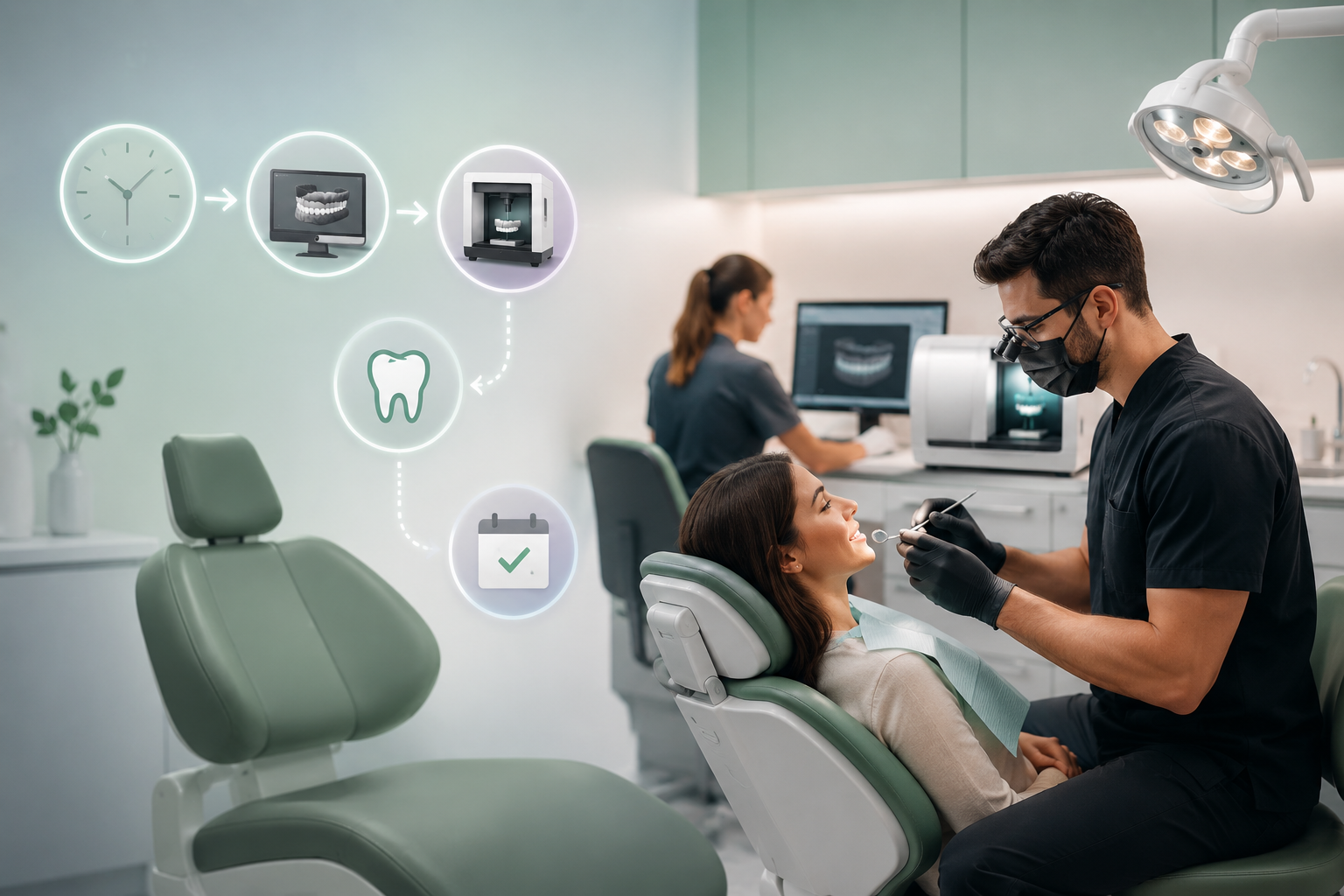
A digital dental lab does not save chair time in one big leap. It saves chair time at every stage of the case. Here is where each of those minutes comes from.
Every minute a patient spends in the chair has a price. It is not just the cost of the operatory, the assistant, or the materials — it is the opportunity cost of the next patient who is not being treated, the case you are not closing, and the productivity your practice could be capturing somewhere else. For most dentists in the United States, chair time is the single most important variable in practice profitability, and it is also the variable most directly influenced by the dental lab you partner with.
Traditional lab workflows were designed in an era of physical impressions, plaster models, manual articulation, and shipping cycles measured in weeks. They worked, but they came with hidden costs: longer appointments, more visits per case, frequent remakes, and patients who left less than thrilled with the experience. Digital dental labs operate on a fundamentally different model — one built around CAD/CAM design, 3D printing, intraoral scanning, and a tightly compressed feedback loop between dentist and technician. The result is the most disruptive change to chairside efficiency the profession has seen in decades.
This article breaks down exactly how a digital dental lab reduces chair time, what that means in real numbers for a typical general practice, and what to look for when you decide it is time to make the switch.
Why Chair Time Is the Most Important Number in Your Practice
Most dentists track production, collections, and case acceptance. Far fewer track the metric that drives all three: chair time per case. A crown delivered in two appointments instead of three is not just a more pleasant experience for the patient — it is a 33% productivity gain for that operatory. Multiply that across hundreds of restorative cases per year and the financial impact is substantial.
Industry benchmarking studies have repeatedly shown that the highest-grossing general practices in North America are not necessarily the ones charging the highest fees. They are the ones with the lowest average chair time per completed case, the highest first-time-fit rate, and the fewest remake cycles. The lab partner sits at the center of all three of those variables.
When chair time goes up, three things happen:
The schedule compresses, meaning fewer slots for new patients and emergencies. The patient experience deteriorates, especially for older or anxious patients who struggle with long appointments. And staff utilization drops, because assistants and hygienists are tied up assisting in restorative chairs instead of running their own production. None of these are visible on a profit-and-loss statement, but every one of them is a direct hit to the practice's growth ceiling.
How Digital Workflows Compress Each Stage of a Restorative Case
A digital dental lab does not save chair time in one big leap. It saves chair time at every stage of the case. Here is where each of those minutes comes from.
Faster, more accurate impressions
Intraoral scanning replaces conventional impressions for the vast majority of restorative cases. A trained operator can capture a full quadrant in under two minutes and a full arch in under five. Compare that to traditional PVS impressions, which require tray selection, material loading, setting time, removal, and inspection — often followed by a second attempt when the first does not capture cleanly. Studies of chairside scanning consistently show savings of 4 to 8 minutes per impression appointment, and that is before you account for the fact that digital scans do not require a re-do after a void or pull is detected.
A digital dental lab is built to receive these scans directly, validate them inside the lab's CAD environment, and start design within hours of submission. There is no shipping, no model pour, no cross-contamination protocol, and no back-and-forth phone call to ask whether the impression was acceptable.
Same-day design and instant feedback
Once a scan is uploaded, a CAD technician at the lab can begin designing the restoration almost immediately. For straightforward single units, design time is typically 15 to 30 minutes. For larger cases, the lab can share a screenshot or 3D preview with the dentist before any milling or printing begins.
This matters for chair time because it eliminates the most expensive variable in case fabrication: the surprise. When a crown comes back from a traditional lab and the contour is wrong, the contact is open, or the occlusion is high, that surprise turns into 20 to 40 minutes of chairside adjustment — or worse, a remake that costs another full appointment. With digital design previews, the dentist approves the case before fabrication starts. By the time the restoration arrives, it is already known to match the prescription.
Precision milling and 3D printing
Modern five-axis milling units and high-resolution 3D printers produce restorations within a tolerance of 25 to 50 microns — well below the threshold of what most clinicians can detect chairside. That precision translates directly into less seating time. A well-designed, well-milled crown should drop in, find its contacts, and require only minor occlusal refinement. The five to fifteen minutes of grinding, repolishing, and re-checking that used to be standard for analog cases simply does not happen at the same rate in a digital workflow.
For implant cases, the impact is even more dramatic. Custom abutments milled from a digital library fit the implant connection with mechanical precision the analog process cannot match. Screw-retained restorations seat the first time, the access channel lands exactly where it was planned, and the whole appointment takes a fraction of the time of a traditionally fabricated case.
Faster turnaround between visits
For dentists who do not have in-office milling, the turnaround time between prep and seat is the second-largest source of avoidable chair time — not because the patient is in the chair waiting, but because longer turnaround means more provisional adjustments, more emergency calls about loose temporaries, and more rescheduled seat appointments when a case slips past its expected return date.
A modern digital dental lab can deliver standard crown-and-bridge cases in three to five business days. Some can do it faster. That alone reduces the provisional management burden on the practice and lets the doctor schedule the seat appointment with confidence.
What Reduced Chair Time Actually Means for Your Bottom Line
It helps to put the math on paper. Take a general practice that averages eight crown-and-bridge cases per week. Suppose the digital workflow saves an average of 12 minutes per case across prep and seat appointments combined — a conservative estimate based on published clinical efficiency studies.
That is 96 minutes of recovered chair time per week. Over a 48-week working year, that is more than 76 hours of operatory production reclaimed. At a typical hourly production rate of $400 to $600, that translates to between $30,000 and $46,000 of additional production capacity per year, per provider — without working a single extra hour.
Now layer in the impact of fewer remakes. A typical analog crown remake rate sits in the 5 to 10% range when measured honestly. Digital workflows routinely reduce that to 1 to 3%. For the same eight-cases-per-week practice, that is 15 to 25 fewer remake appointments per year, each one costing the practice approximately one hour of lost production. Add another $6,000 to $15,000 in recovered capacity.
The numbers compound. Recovered chair time becomes new patient appointments, which become hygiene recalls, which become future restorative cases. The practices that adopted digital workflows early are not just more efficient — they are growing faster than their analog peers because every saved minute becomes a reinvestment in the practice.
The Patient Experience Multiplier
Reducing chair time is not only a financial story. It is a patient experience story. Patients today compare every healthcare visit to every other consumer experience they have. They compare your appointment length to a same-day appointment at their dermatologist, an in-and-out visit to their optometrist, or even the speed of an Amazon delivery. When a crown takes three appointments and a month to complete, you are competing against a benchmark you cannot win.
Digital workflows allow you to set a different expectation. Two appointments, fewer adjustments, more comfortable bite registration, cleaner impressions, and better-looking final restorations all add up to a patient who is more likely to refer their family, accept treatment plans, and stay with the practice for years. Patient retention is the cheapest form of marketing in dentistry, and chair time efficiency is one of its biggest drivers.
When the Digital Workflow Does Not Save Chair Time
Honesty matters when you are evaluating any workflow. There are situations in which digital does not, by itself, reduce chair time. The most common is when the practice has invested in a scanner but is partnered with a lab that still operates analog at its core — printing models from the scan, pouring stone, and waxing up by hand. In that case, the practice has digitized only the impression step. The rest of the savings depend on the lab being digital from end to end.
The second is when the case submission is incomplete. A digital lab can only deliver a same-day design if the scan, photographs, shade selection, and prescription arrive together and are accurate. Practices that submit partial cases, expect the lab to chase missing information, or skip the photographs lose much of the chair-time advantage they were paying for.
The takeaway is simple. Digital workflows reduce chair time when the dentist and the lab are both operating digitally and the case submission is complete and accurate. Anything less is half the system, and half the system delivers less than half the result.
Five Questions to Ask a Lab Before You Switch
If you are considering moving your cases to a digital dental lab, the conversation should start with these five questions:
The first is about technology. What scanners does the lab accept, what milling and printing equipment is in-house versus outsourced, and what is the lab's average turnaround time for a single-unit crown? The second is about communication. Does the lab provide design previews before fabrication begins, and how quickly does a technician respond to a question about a case? The third is about quality. What is the lab's published remake rate, and what is its first-time-fit rate on implant cases? The fourth is about scope. Can the lab handle the full range of cases your practice produces, from single crowns to full-arch implant rehabilitations and aesthetic veneers? And the fifth is about the partnership itself. Does the lab see you as a vendor or as a partner, and is there a dedicated point of contact who knows your preferences, your shade tendencies, and the way you like cases finished?
The answers to those questions will tell you everything you need to know about whether the lab will actually reduce your chair time or simply add a digital coat of paint to an analog process.
Building a Practice Around Reclaimed Time
Reducing chair time is not a one-time project. It is a continuous compounding advantage. Every case that comes back faster, fits better, and seats sooner gives you the capacity to take on the next case faster. Over months, that capacity becomes a new operatory. Over years, it becomes a new associate, a new location, a new revenue line.
The practices winning the next decade of dentistry are not the ones working harder. They are the ones building their workflow around precision, predictability, and partnerships that respect the value of their time. A digital dental lab is not a vendor that ships you crowns. It is the operational backbone that determines how much production you can capture from the schedule you already have.
Partner With a Digital Lab That Respects Your Schedule
PROCERAM Dental Digital Lab has spent more than three decades helping dentists reclaim chair time, eliminate remakes, and deliver restorations patients are proud to wear. Our fully digital workflow — built on advanced milling, high-resolution 3D printing, and a CAD design team that treats every case like its own — is designed around one promise: precision the first time, every time, with the fastest turnaround in the market.
If you are ready to find out what your practice could produce with eight, ten, or fifteen extra minutes per restorative appointment, we should talk.
Contact PROCERAM Dental Digital Lab today: Phone: +1 (385) 425-8770 Email: Office@ProceramDentalLab.com Web: www.ProceramDentalLab.com Located in Draper, Utah — serving dentists nationwide.
